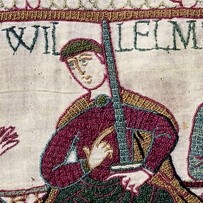
In writing a book about the great sweep of Norman history from 1066 to 1135, I had to face up to the challenge of writing about the Conqueror. Not to do so would seem like a cowardly omission. But how to do so? An infinite number of books, articles and papers, ranging from learned studies by reputed historians, to popular magazine histories and TV series, and just about every other possible iteration, meant that doing so was fraught with difficult choices.
I don’t know if this was foolish or overly ambitious or just plain wrongheaded, but in the end I chose to begin the book with a strong focus on the magnificent ego of this man, on the individual mind and soul, poised at the most extreme point of life where the approach of death is known and perceived. What were those ultimate moments like? Moments where one’s life passes in review, when the naked self is questioning final things and time is no more than the duration of pain. Did he find solace in Christ? At the end, was he a repentant Christian man? Or was he just the Conqueror?
Injured and dying, knowing himself to be dying, William the Conqueror lies contemplating his own personal mortality at the moment he is about to pass into the immortality of enduring fame. I wanted to get inside the mind of this man as the fever burns during his long-drawn out and agonising death. Who and what was this phenomenal man? A giant figure even now, almost a thousand years after his death.
So Chapter One “The Death of William the Conqueror” in Deaths, Disasters and Destinies: Anglo-Norman History in Twelve Lives had to set the scene of the period with a focus on the initiator of the Norman destiny in England. To do this I felt it would be best to use an interior monologue style to give dramatic access to William’s point of view. A dying man assesses his life; what does he regret, what does he hope, what does he believe, what does he remember? What are the sources of pride or guilt in the ebbing of life? How to unlock all this? It can’t be done of course. But, since the ‘historical’ and ‘factual’ aspects of the chapter are well established and can be found in academic accounts of the period, I have stuck to them in regard to dates and times, places and events.
Of course we can’t possibly know the real story of this death.
But, also, of course, we can’t stop ourselves speculating.
In an example of ‘interiority’, William talks to himself during a night of burning fever:
‘If your father had ever made a proper Christian marriage,’ said a voice in his head, ‘you would not have stood a chance. Legitimate sons would have taken all the prizes. You would have been at best a menial, at worst a fatality. Bastard sons like you were put out of the way, often as not, or else consigned to the church. Your father, Duke Robert, never got the sons he wanted, sons sanctioned by the church, born in wedlock with a noble lady. Justice perhaps. He was an old-fashioned war lord. A semi-brute. How I adored him!’
And in his rambling William would answer the voices that came and went, weaving into consciousness and out again as he held conversations with himself.
‘And whatever you say of me, you out there in the darkness, hovering by my bed, whatever you say, I was worthy of more than a dukedom, as proved when God gave me victory in England. Cruel, we all were, had to be or else lose power, weaken, become prey. But I was never rapacious, or wanton. No, never.’
This kind of interior monologue alternates with the authorial or narrative style:
“In the way of fevered men whose sleep is fitful and intermittent, William sometimes spoke and seemed lucid, giving orders to ministers or household servants, sometimes he lay for hours in hectic sleep, people with dreams and loud with voices.
This chapter is dedicated in spirit to the early chroniclers, whose work gave colour to the dry documentation of the period. They were almost all monks, men like William of Malmesbury, Orderic Vitalis, Henry of Huntingdon, William of Jumieges and, perhaps the most vivid writer of them all, Eadmer, a monk of Canterbury who wrote the Historia Novorum in Anglia (History of Recent Events in England).
These writers tried to tread a path between fact, hearsay, recollection and, often, divided allegiances. As Christian historians they were shaped by the historical understanding that God played the dominating role in history. The purpose of history, they believed, was to teach moral lessons. History, therefore, teaches people about what happened, what can happen, what God allows and what he forbids.
An example of this practice can be found in Orderic Vitalis’s account of the death of William the Conqueror. Orderic emulates classical historians by putting detailed and dramatic speeches into the mouths of protagonists. Thus, the Conqueror is given a moving death-bed speech of contrition, lamenting his manifold sins and the cruelty of his conquest. It is this kind of interpretation I hoped to emulate. The chroniclers undoubtedly wrote vivid history using the facts and evidence that came to hand, but they also employed classical rhetorical devices and their own imaginations. In doing something similar I hope to pay respect to their invaluable work – without them we would truly be in the dark.
William’s death was a long-drawn out agony of several months duration, from July 1087 when he was injured by the pommel of a saddle when his horse stumbled, to September 9th 1087. As far as we can make out, he was taken to the Priory of St Gervase in Rouen where clergy, courtiers and family members gathered. Physicians attended him but were unable to save him.
I imagined that sometime, as death approached, his thoughts would turn to the supreme moment of his life. The great victory. The event that earned him, uniquely through the whole of England’s subsequent history, the title of Conqueror. I imagined that he might dream up the old enemy, Harold, and converse with him in an internal re-encounter.
“We were so alike when you examine the thing closely, weren’t we, Harold? Evenly matched in everything. It could have gone either way. But your luck ran out. And mine held. Well, it does no harm to have the Pope on your side. And you perjured yourself. I always maintained that. I started the rumour. I tricked you into that oath. But it didn’t matter because you didn’t keep your word any more than I did. We were at evens for everything until the last hour of that day.’
“He lay still, eyes closed, listening. The last sense to leave the human body, a wise old monk once told him, is hearing. He saw nothing, he felt nothing, but he could hear sounds coming to him through the darkness, a muffled singing, but close, very close.
“Listen to them, getting ready to see me off. But, truly, truly, I am contrite. Dear God forgive my manifold sins and grant me grace. On the other hand, I would stay around just to spite them. What would you say to that, Henry? William, eh? Robert? My dear sons, my boys. Why do I spend so much time thinking about you? It’s too late now. Matilda and I made you men fit for the times, that’s all to be said. The times are harsh, the world is cruel, men are greedy, weak or brutish. Amen.’
A second great enterprise with which William is associated is, of course, ‘The Domesday Book’, the name by which we know the great survey of English lands, the Great Description, as it was sometimes called, or, as defined by the historian Michael Woods, ‘a tax or geld inquest.’ This collection of manuscripts, bound into tomes, is a comprehensive overview of the country, giving a snapshot of land ownership in 1086 and in the earlier reign of King Edward (1042 -1066). This double view enables us to get a clear understanding of the magnitude of the great land transference that had taken place as well as the estimated wealth of the new Norman aristocracy.
But what William wanted, even more than the calculation of wealth gained in the Conquest, was the knowledge of who owed him what. Not only the knowledge, either, but some way of ensuring the loyalty of his newly enriched elite. If they became too wealthy, too independent, they might entertain disloyal ideas.
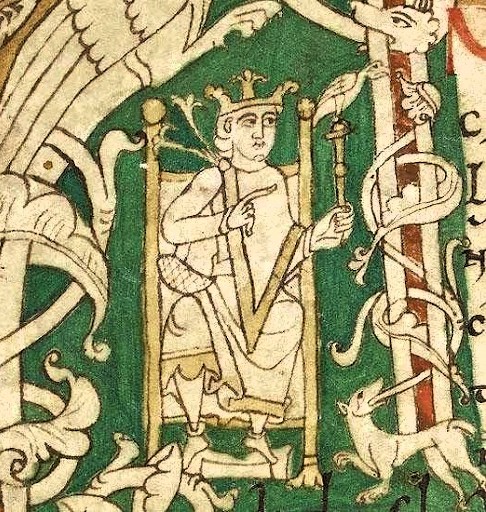
This is where the Oath at Sarum comes in.
What was the Oath of Sarum? Basically, it was William the Conqueror’s insurance. He had just given enormous power in the form of wealth and lands to a cadre of war-lords whose potential for fomenting trouble in England was enormous. They had sworn oaths to him, of course, but that was before they got quite so powerful, when they were just Norman barons. Now, as William had to distribute the booty of the Conquest, these barons suddenly became powerful magnates, controlling estates and honours worth a fortune and able to arm and sustain numbers of fighting men. /William needed new oaths, new assurances of loyalty. Every single one of the warlords who had benefitted from the redistribution of lands, plus the newly installed Norman clergy who, by 1070 occupied every single one of the great dioceses of England, had to take the Oath of Sarum.
An oath of loyalty to William, sworn at the old capital of Sarum, the original holy site of Salisbury, in a formal and solemn oath-taking ceremony was to provide William with the confidence he needed in his newly ennobled aristocracy. Everyone must swear. Everyone must agree that William, and William alone, had Conquered England. He ‘generously’ shared the spoils but the new elite must acknowledge William’s supreme dominance. And there he is at Sarum in the manuscript illumination (above) with his extremely long forefinger, pointing out the simple truth that he alone is, and will remain, King and Conqueror.
The enterprise of making the Domesday Book was carried out largely between Christmas 1085 and summer 1086. William announced his intention at the Christmas Court of 1085 and the Oath of Sarum marked a kind of completion date on Lammas Day, August 1st 1086.
How this amazing undertaking was put into effect by the employment of twelve Crown Commissioners, who travelled the country calling inquest courts in regional centres, is described in my novel The Domesday Murders.