The prejudice against Jewish people probably began in a Christian ‘blame culture.’ Jews were blamed for the execution of Jesus centuries before. They were blamed for calling for the release of the rebellious fanatic, Barrabas, instead of Jesus who was thus condemned to death by the Roman governor, Pontius Pilate. This version of history is said to be one of the originating causes of anti-Jewish sentiment. Judea, home of the Jewish people in Roman times, was the most unstable province of the Empire, wracked by revolt and rebellion. This led eventually to the capture and destruction of the Temple and the ultimate exile of the Jews from their homeland.
The first recorded presence of Jewish people in England dates from just after the Norman Conquest. It is likely that William the Conqueror, needing money for his proposed conquest of England, extracted it from rich Jews in Rouen. Some of these families then followed him to England, being recorded for the first time in 1070.
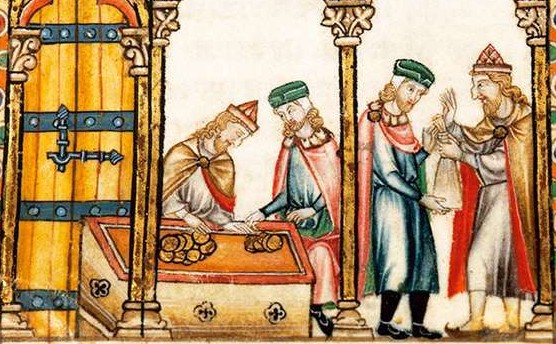
Moneymaking, loans and debts was the area in which a Jewish presence flourished. This was because of the particular Christian attitude to usury: charging interest on a loan. The crucial thing here is that the loan operates over time. Lending money in a system where debt accrues over time was not permitted to Christians. Why was this? Because Time is God-given. Each person has a span of Time in which to live as a good Christian should. It is therefore wrong to employ Time in order to accrue that which you have not earned. Thus usury was a sin.
In my novels Aefled and Eleanor and The Domesday Murders, I invent a character, Isaac, who embodies this Jewish presence and has indeed lent money to one of the Norman invaders. Isaac is highly educated, wise and informed. He has studied under the best Moorish teachers in Spain and spent time at the learned centre of Toledo. He comes to England with the invasion under the special protection of a Norman nobleman and so he is allowed to travel more widely than most. Both these novels are set before the time when rabid prejudice takes a hold.
William the Conqueror and his successor, William Rufus, use the Jewish merchants to suck up monies for their various projects. Jews are allowed to make money but are also forced to lend it at favourable rates whenever it is required. Thus they have little autonomy. Many restrictions apply. In London they are concentrated mainly in the Poultry district and are not allowed to travel freely, they have few legal rights and are, when involved in legal disputes, forced to take oaths on the Bible instead of the Torah. They are not allowed to hold lands, fiefs, and pledges safely so they cannot be reliable creditors. In short, their lives and livelihoods are restricted and curtailed at every turn.
Following in this tradition, when Henry 1st needed money in 1099 to foment disorder in Normandy to undermine the rule of his brother, William Rufus, he borrowed heavily from the Jews of Poultry. Later, for his invasion of Normandy in 1106 to put down the last pockets of revolt, Henry needed yet more funds and again turned to the Jews.
Apparently, he raised vast sums in this way, possibly on the back of promises to the Jews that he would reward them with a Charter which would guarantee them some rights. The word of Kings trying to borrow money should be treated lightly, so probably, the Jews did not place much faith in such promises.
However, such a Charter was issued sometime during Henry’s reign which lasted from 1100-1135. It enshrined a much more lenient policy towards the Jews in England and gave them a brief respite before the massacres and persecutions which took hold in 1189 and 1190. Thereafter the English scene for Jews was increasingly hazardous, culminating one hundred years later in 1290 with their total expulsion in the reign of Edward 1st.
But what did King Henry’s Charter offer to the Jews?
- Jews were allowed to hold lands, fiefs and pledges. They could own property. This, essentially, protected their ability to act as creditors.
- They were granted Legal Rights by permission to be tried by their own communities rather than local town courts.
- Right of Movement. Jews were exempted from the usual tolls and restrictions. They were able to move themselves and their goods freely throughout the kingdom.
- Their ‘protection’ lay in their special status as ‘property’ of the King. This may be viewed as a form of exploitation because they were free to make money for the king, unhampered by local restrictions or prejudices. They were free to lend money at interest and make a profit, which the King could then take. They were serfs of the king but that gave them a protected status and they could not be wantonly harmed.
Indeed, for its time, this Charter is something of an advance for the Jews of England. The Charter was reconfirmed by later kings, including King John. Sadly, by 1290, this advance is lost. Prejudice and intolerance strengthen into persecution and finally Edward 1st exiles them from the land that had become home to so many. It is a sad tale and one that is repeated in every age.
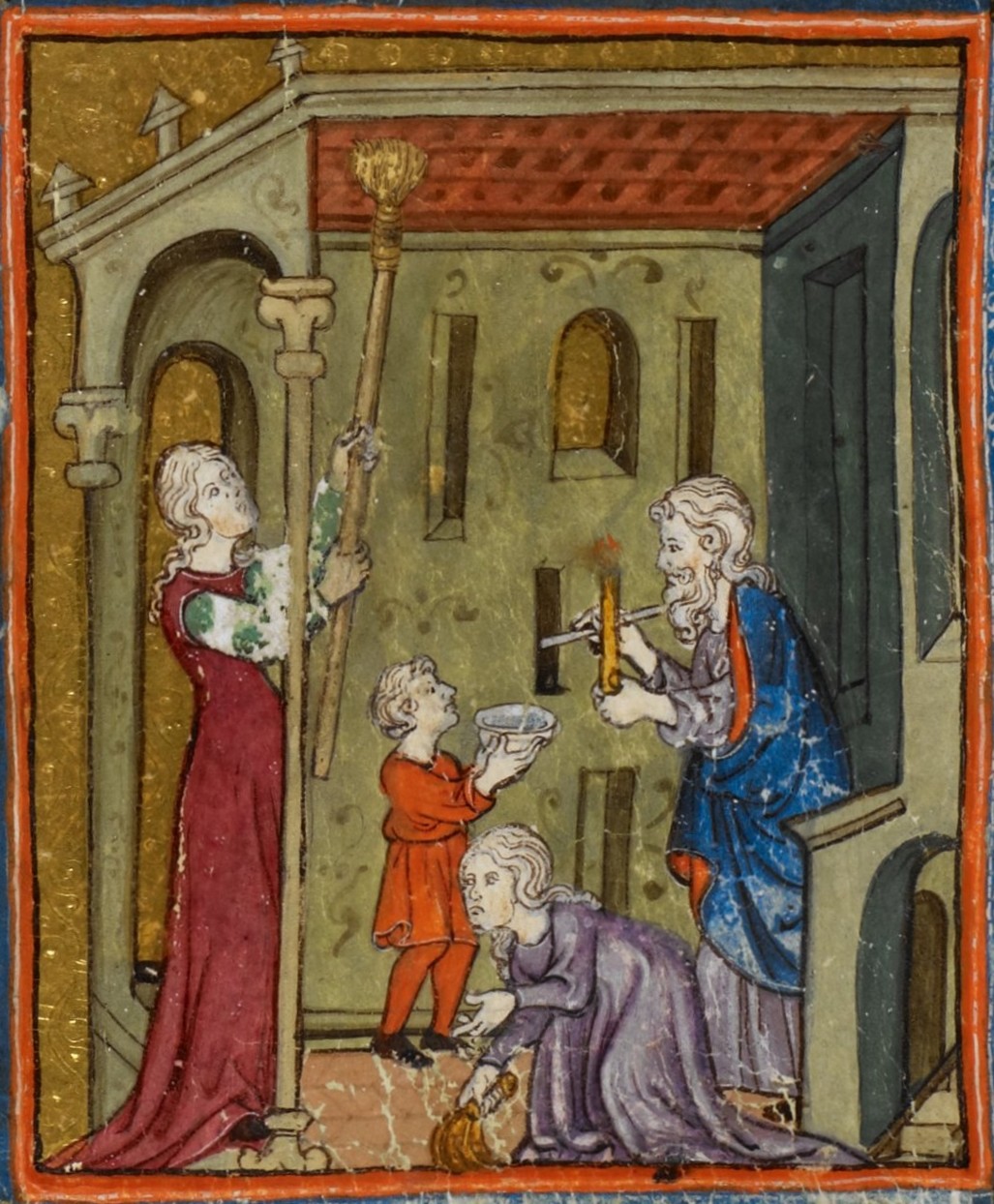
The picture above represents Jews in Spain preparing to celebrate Passover. In Spain, as in England, there were times when Jewish populations were allowed to celebrate their rituals in peace. In Oxford in particular, Jews enjoyed a period of good relations with Christians under the protection of the king. They even attended each other’s celebrations; friendships were formed and there was a degree of mixing, although intermarriage was forbidden. Sadly, the period of peace did not last.
The Charter of the Jews in After The Arrow
As can be seen, the Charter of the Jews was a crucial document which led to the increase in welfare of the Jewish population and their ability to supply money. So crucial indeed was this document that I wanted to give it a presence in my novels. In fact, the reading and reception of this Charter is dramatically reconstructed in a scene set in Poultry in After the Arrow.
One day Robert of Castle St Mary’s, a trusted and confidential servant of the king, goes to Poultry for a meeting with Rabbi Joseph, the Chief Rabbi and leader of the Jews residing there. They meet in his merchant’s workshop where men are plying their various trades. Robert hands him a draft of the proposed Charter (After the Arrow, p. 186):
Rabbi Joseph read it in silence. After a long time, he read it again, aloud. “This is remarkable,” he said. “This is the working of God’s purpose for the deliverance of his people. We thought we had been forgotten. We thought the king, like all other kings and princes of the earth, is full of honey and sweets in his promises and then delivers gall.’
Showing every sign of excitement, Joseph called to his workmen and summarised the Charter for them. “Listen to this, he said, “this is what the king will grant us: Permission to move about the country without paying tolls. To buy and sell goods and property. To sell pledges after holding them for a year and a day. To be tried by our peers and to be sworn on the Torah rather than the Christian Bible. Further,” added Joseph, “it is established that a Jewish person’s oath is to be valid against twelve Christians.”
The listeners looked at one another doubtfully. They did not believe him and asked him to repeat the clauses which he read out word for word. In spite of Joseph’s enthusiasm, the response of the others was muted. To them it represented more promises, more words, more scope for future disappointment. And it would be followed, inevitably, by more demands.
[…]
‘How much does the king want?’ asked Joseph.
‘Nothing yet. But he has told me to say assistance will be wanted in the near future.’
‘Well, we could not expect anything less. But it pleases me that Henry has kept his word. He promised us a charter long ago. When I first told you, you did not believe me, do you remember?’
Robert did remember. He remembered in those days Henry had no right to promise any such thing. He had exceeded his authority, perhaps even treacherously. Had he been planning, even then, to strike against his brother? King William Rufus, dead in Brockenhurst Forest, killed in a so-called hunting accident, was what had made the charter possible.
Finally…
In many written accounts, the period between 1170 and 1189 shows evidence of good relations between people of different faiths and backgrounds. As has been suggested, tolerance, acceptance, even friendships, are recorded. Ordinary people could relate on terms of civility and friendly social interactions were, if not commonplace, then at least known to occur. There is also evidence of the peaceful coexistence of people of different backgrounds as late as the thirteenth century, even records that Christians attended Jewish weddings. Unfortunately prejudice and active persecution seems to have been incited by the powerful representatives of the Church, the Crown or the aristocracy. Then, as now, the populace could be whipped up by false tales to hatred and intolerance. People could be manipulated by lies, as they are now, and this led eventually to reprisals, false accusations, persecution, and eventually to the complete breakdown in relations.
A sad and instructive lesson.
Unfortunately, we never learn from history.