Wilton Abbey no longer exists. I went to Wilton, three miles from Salisbury in Wiltshire, looking for it, but it was gone.
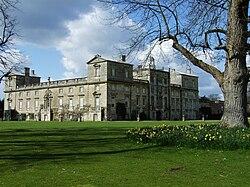
In its place, to be sure, stands a marvellous stately home, set in beautiful grounds, but no vestige of the Abbey remains, not even a few bumps in the ground or heaps of stone. It is utterly gone.
If I wanted to represent Wilton Abbey in my novels I had to imagine it as completely as any other historical character. I had to try to evoke the people and the place as they might have been in the period from the Conquest to 1109 – the time period covered in the novels: The Remarkable Tale of the Bull and the Sheep and After the Arrow.
A few things are known. In 1003 Sweyn, King of Denmark, destroyed the town of Wilton but it is unknown whether the abbey shared its fate. Edith of Wessex, the wife of Edward the Confessor, who had been educated at Wilton, rebuilt the abbey in stone; it had formerly been of wood. Much more is known about the later years up to the Dissolution but this was too late for my purposes. I had to focus on the years after the Conquest.
What interested me was trying to recreate the place in regard to both fabric and atmosphere and most particularly the educational reputation of Wilton. This Benedictine nunnery was a place where the daughters of royal, noble or aristocratic families could be educated in the exercise of their religious duties and in the skills of reading and writing the Latin language. This was necessary because, when they were married, they might be called on to write to prominent people on behalf of their husbands, or even in their own right, to convey important matters privately. If they remained in the church and were appointed to high office, abbess or prioress, they would need the skills to oversee and run a large organisation and communicate with sister houses abroad. Literacy was valued and high-status women and girls were afforded a first-class education there. It was one of the finest Benedictine nunneries in Europe.
Benedictine Rule
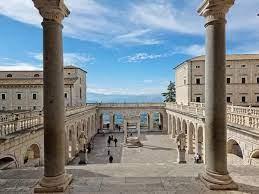
Benedict of Nursia founded the monastery of Monte Cassino in Italy in 530 AD and developed the way of religious living known as Benedictine Rule. The Rule was written as a guide for monks living under the authority of an abbot and consists of seventy three short chapters of spiritual wisdom combined with administrative advice. It places the emphasis on obedience: to God, to the Rule, to the Abbot. Humility, obedience and moderate asceticism were its basic tenets. In writing the Rule, Saint Benedict contributed more than anyone else to the rise of monasticism in the West. His Rule was the foundational document for thousands of religious communities in the Middle Ages. Even now, the Rule of St. Benedict is the most common and influential Rule used by monasteries and monks, more than 1,400 years after its writing.
Principles of the Rule
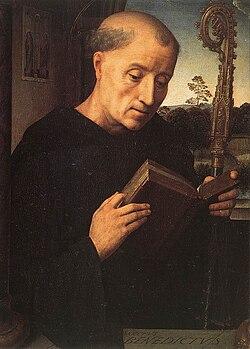
These were designed to govern monks living in a community, recognising that people, living together, must have rules. St Benedict bases the day on ‘orare et laborare’ (work and prayer).
Saint Benedict’s model for the monastic life was the family, with the abbot as father and all the monks as brothers. Priesthood was not initially an important part of Benedictine monasticism – monks used the services of their local priest. Because of this, almost all the Rule is applicable to communities of women under the authority of an Abbess. In fact you might say women gained an advantage by committing to Benedictine authority.
However we do not know enough about the running of Wilton, nor the administrative abilities of the Abesses to be able to say if the abbey conformed strictly, or loosely, to these principles.
Undeniably, though, Wilton in the years immediately after the Norman Conquest could not have escaped the general turmoil of those times. We know of women in flight seeking shelter and protection there, women who had lost their menfolk in the battles, women with property, heiresses who were in peril of being forcibly abducted. Among them were two very distinguished women: Gunhild, daughter of King Harold, and Edith, daughter of the King of Scotland. These two women play a prominent part in The Remarkable Tale of the Bull and the Sheep and After the Arrow.
BUT how to portray Wilton when none of it remains? Such facts as we do know contribute mysteriously to build a picture of an entirely unique and exceptional place, both for the variety and prominence of its residents, which must have generated a distinctive atmosphere, and for the material fabric of its buildings. If Edith, wife of Edward the Confessor, had it rebuilt in stone it may have been of Norman design or of an earlier Anglo-Saxon style, a style remarkable for its arches, both rounded and pointed, its patterning and decorative use of Roman tiles, as the few surviving examples demonstrate.
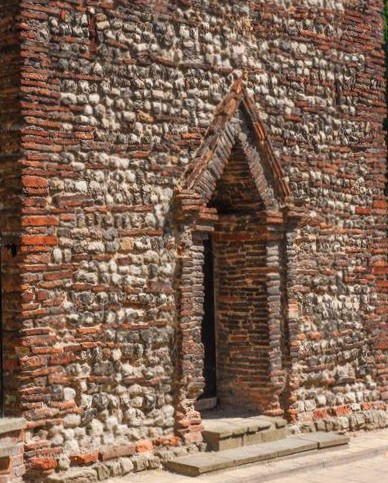
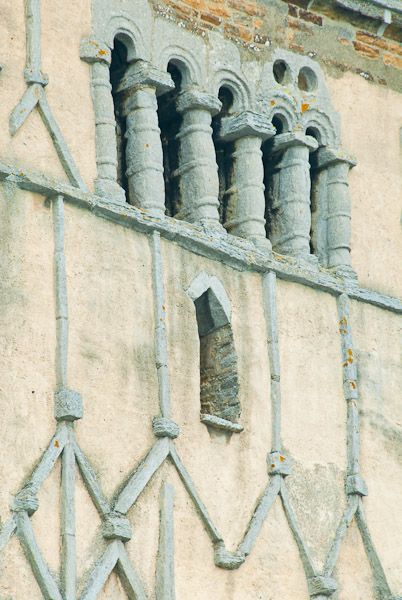
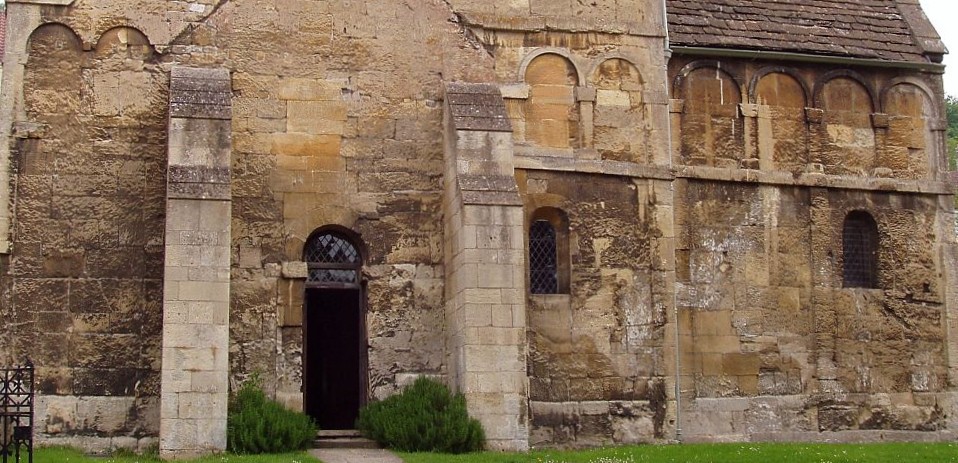
My way into Wilton, however, was not so much into the building through doorways or arches but into the atmosphere of the place. Among such a diverse group of women a genuinely unique atmosphere must surely have existed. Some were refugees, some high-born or royal heiresses, some servants of others, some confessing nuns, some novices or secular women with interests in land and fortunes. All this produced a mixture of fates and fortunes, of people high and low: all were thrown together in the turbulent aftermath of conquest when a land-grab of staggering proportions was underway. Surely this was a unique and extraordinary place.
I was particularly interested in two famous women who were resident at Wilton at the same time and may well have known each other. The younger, Edith, daughter of the King of Scotland, was still a child in 1093 at the opening of The Remarkable Tale of the Bull and the Sheep, the elder was Gunhild:
“Gunhild was the daughter and last known descendant of the English King Harold. Like many of the women at Wilton, she was an heiress seeking refuge from the Norman land-grab. This made Wilton something of a unique institution. Noble and royal women were educated there. Heiresses, secular women, wards of the king, were given protection. It was a place where refugee stories of violence and suffering were swirling about with stories of privilege. It was both a Benedictine nunnery with a high reputation for scholarship and learning, and a sanctuary for women who made no pretension to the conventual life but were simply seeking the shelter of the church in lawless and violent times. Those heiresses who still possessed legal entitlement to pre-Conquest estates were often in danger of being forcibly married, kidnapped or even murdered by ruthless warlords. In the violent and lawless years of the 1070s, many crimes were committed against the women who had already suffered the loss of their menfolk. As it happened, Gunhild still had entitlement to lands bequeathed by her mother, Edith Swan-neck. She was an heiress with a considerable inheritance which she fully expected, in due course, to bring to the abbey. It was widely understood, so she believed, that on the day of her appointment as abbess she would convey her landholdings to Wilton. But in 1093, Gunhild was not even technically a nun. She had taken no vows before a bishop and although she wore the habit and sometimes the veil, she did not regard herself as consecrated to the religious life although she was deeply committed to the Benedictine order. Well-educated in holy texts and scripture, she had no thought of changing her life but rather had in view, as a serious but not imminent prospect, one day achieving the office of abbess.”
The Remarkable Tale of the Bull and the Sheep (p. 83)
So it is likely that Gunhild assumed that she would one day become abbess. She would never have seen herself at the heart of a love story. Insofar as it can be established it is a love story so tragic and dramatic that it really ought to the subject of fable.
To find out more about this extraordinary true tale see After the Arrow.
How Did Wilton Get Rich?
All the many pieces of land with their revenues are listed in the Domesday Book of 1086. The Abbey kept its endowments of land from before the conquest and went on receiving donations, gifts and legacies without interruption. In 1086 its income from property amounted to £246. 15s and was the highest gross income of any nunnery in England.
The Abbesses had special status because the Abbess of Wilton held an entire barony from the king, a privilege shared by only three other English nunneries, Shaftesbury, Barking, and St Mary’s Abbey, Winchester. As the head of a barony, the Abbess had the obligation to provide the royal army with knights when summoned to do so. She also had the privilege to appoint office holders which made her an important patron; her most prestigious case of patronage was her right to appoint deacons to the conventual church, which meant she could appoint a high number of clergy to selected posts, thus distributing favours as she wished. In addition, Wilton Abbey was favoured by the royal family and given many rich donations from members of the royal family, such as from Henry I and Queen Matilda.
The king, the Archbishop of Canterbury, the Bishop of Salisbury, and sometimes the queen, had the right to nominate nuns to Wilton, and the king exercised this right on his coronation and on the creation of a new Abbess, and the queen on her coronation.
Yet all this privilege entailed heavy obligations. Most weighty was the providing and equipping of knights to the king. This was a hefty responsibility. Men had to be drawn from the land, trained and equipped. The main expense of knighthood was the horse. These highly trained animals, bred for warfare, were expensive to keep and equip. The development of the couched lance position, whereby a man could lower his lance at full gallop and keep it steady, striking his adversary head on, required the development of a special saddle and handling technique.These problems seem far removed from the affairs of a nunnery, and yet the Abbess must make it her business if the nunnery was to maintain its privileged status.
So the office of Abbess was a prestigous and a powerful one in the limited sense that women were only partly powerful. Women were always in need of male protection in the exercise of power. A favourable relationship with an Archbishop, or highly placed male relatives or personal connections with a monarch were often to be found in the background of any Abbess of this era.
Edith of Scotland
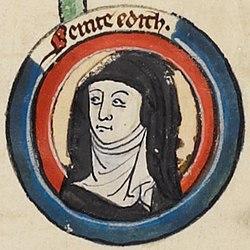
Perhaps Edith of Scotland or perhaps Saint Edith who was a particular saint of Wilton Abbey and had a shrine there.
Edith was the daughter of the King of Scotland, sent south for her education, first at Romney Abbey and then at Wilton, with her younger sister Mary. They were accompanied by their aunt, Christina, who was the sister of their very pious mother, Margaret, who later became a saint. Christina herself was most probably a nun and most probably expected Edith to follow her into the religious life. She would be sorely disappointed. These facts were tantalising. But as I researched further even more startling facts came out about Edith’s time at Wilton, involving scandal, an Archbishop, and a clerical inquiry. It was part of Edith’s struggle to live the life of a woman in the world, not a nun. A woman in the world, was supposed to marry. She was very likely to become a mother. What did Edith know about these things?
What fascinates me is how medieval nuns dealt with issues not just of sexuality and desire, but of their own bodies. How did they understand menstruation? What were they told about its cause and how to deal with it? It is on this question that I started to build my picture of young Edith. In The Remarkable Tale of the Bull and the Sheep, I imagined that her domination by Christina caused her considerable unhappiness, because Christina wanted her to become a nun whereas her father, the King of Scotland, wanted to use her in the high-stakes marriage game. But worse, Christina’s attitude was depriving Edith of a proper preparation for life as a woman.
“Christina wanted to make her a nun. Her father wanted to make her a queen, or at least the wife of a high-ranking nobleman. Many men wanted her as a trophy. To Edith, this had all been a game in which her importance was gratifyingly magnified. She had strung her aunt along with her charms and pretences, believing she could always have her way. But with the onset of her menses, the game had suddenly become serious, threatening, frightening. It thrust her out of childhood into that murky, ill-understood world of adult relationships. Confronted with the real prospect of marriage, she had panicked and that state of panic had laid her low [….] in refusing food she had weakened her body as though punishing it for escaping her command. Bleeding and the accompanying pain were like the afflictions of a disease that might be treated by fasting, a widely accepted practice in conventual houses where stick thin nuns boasted that they had escaped the curse.”
The Remarkable Tale of the Bull and the Sheep (p. 66)
This leads me to the conjecture that Wilton was a place that could be frightening to a child, even a privileged child, even one receiving a first class education. I imagine that Edith and her sister, Mary, share their fears and support one another against their overweening Aunt Christina. I see Edith as a fighter, resilient, perturbed but unbowed, able to enjoy the life of the nunnery with its farms and animals, its bee-keeping, its lakes and fish-ponds. I see her conforming to the work ethic of the Benedictine order, working hard at her lessons so that in the future she will be able to write subtle letters to men in high office with confidence and style. I see Edith taking charge of her little sister: two spirited girls, fighting their fears, walking in the cloister with conspiratorial whispers about the quirks of various nuns, successfully resisting the pressures of their dominating aunt while taking advantage of the education they are being offered, steering a path between piety and wordliness. I see them both, but Edith in particular, in spite of all the Benedictine emphasis on humility and obedience, as ambitious, resourceful, somewhat daring, clever and watchful. Wilton produced her and her life confirms the shaping power of that long-ago Abbey which has now utterly disappeared, leaving no trace save in the lives that were lived there.
See After the Arrow to find out what happened to Edith and Mary.