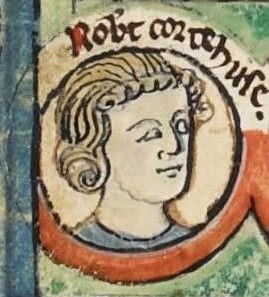
Eldest son of William the Conqueror, Robert Curthose is an endlessly interesting character to write about because he brings a rich set of weaknesses and foibles to the novelist, yet he is, too, an undeniably significant presence in the decades 1087 to 1106. One of the challenges historians and novelists face is how to present such a kaleidoscope of weaknesses and strengths, of successes and failures, of deep internal wounds and strong determinations; how is one to interpret such a figure?
I chose to begin by considering the name ‘Curthose.’ It was, and was meant to be, a belittling insult, and it clung to him from an early age. It means something like ‘short legs’ and we presume its purpose was to draw attention to his lack of height.
From there it was easy to consider his upbringing. Continual mockery from youth seems to have been his lot, both father and brothers openly using the name. Naturally courtiers and servants would take their cue from his family and from what we can glean from anecdotal records, Robert’s formative years were far from easy because he was subjected to continual insult, belittlement and neglect.
In addition:
“Robert bore the full brunt of his father’s ambitions. That is to say, during the whole period of his childhood, until the age of ten or twelve, his father was engaged in the subjugation of Normandy, fighting constant battles, often surrounded by enemies… Fierce, blunt, remorseless, absent, William was never going to be the best of fathers.”
Extract from Deaths, Disasters and Destinies: Anglo-Norman History in Twelve Lives (p. 275)
In fact, William seems to have been, even by the low standards of the time, not only a bad father but a needlessly cruel one. This was my way into the character of Robert. It seemed to explain or suggest much about the bruised, unhappy child, the unlucky rebellious youth and the ill-starred man. Why did he fight so doggedly with his father, why was he never knighted, as he should have been and as his brothers were, and why did he carry a distrust of his own self-worth for so long?
These were fascinating questions, not all with answers, but all worth considering.
Robert Curthose had a turbulent life and when achievement came it could not be sustained. After a lacklustre youth, a failed rebellion against his father and years of estrangement from his brothers he found fame and success two thousand miles from his homeland, in Palestine and Syria. He was not only separated from Normandy by distance, he was separated from it by an extraordinary financial transaction – a land deal contracted with one of the most unreliable of men, his own brother, King William Rufus. But under the Syrian sun, far from home, he was briefly granted a chance to shine.
His transformation began with a call to arms by Pope Urban in November 1095 at the Council of Clermont. This was a momentous event which shaped the course of relations between Europe and the middle east. The Pope, in response to an appeal by Alexios Komnenos the Emperor of Byzantium for military aid against the invading Seljuk Turks, made a powerful and effective speech which sold the idea of a middle eastern war to a whole generation. Thousands answered the call, leading to massive departures of armed men in the following years. Among them was Robert Curthose, Duke of Normandy.
The Pope promised that all those who went as warriors to the Holy Land would be granted absolution for all their committed sins. They would be cleansed and shriven of all sin. To a man who showed every sign of genuine religious sensibility, this must have been quite an inducement. But we don’t know why Robert Curthose made such an uncharacteristically bold choice of action. Was it a decision taken in haste, a passionate response to a sermon, a way of escaping disappointment, a throw of the dice, a moment of madness or the brightest idea he had ever had?
The mortgaging of Normandy
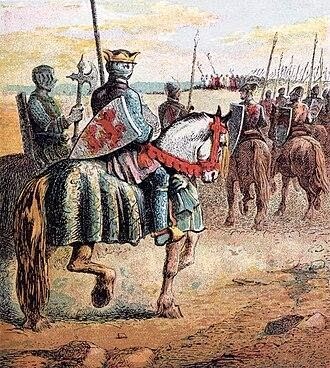
For whatever reason, Robert Curthose decided to throw in his lot with the warriors in support of the Christian monarch in Byzantium. However, there was one immense problem. He lacked the funds. He needed financial backing. He needed a huge reserve of cash in order to take a representative army to the Holy Land and maintain it. He needed money. Some he could raise from fines and forced loans, some from the Jews, but that would not be enough. The plan he came up with, perhaps greatly encouraged by his brother, William Rufus, was to mortgage his entire duchy to the English king for three to five years in exchange for the sum of 10,000 silver marks. After the agreed period he would have to redeem the mortgage or transfer all rights to Normandy to his brother.
To William this might have seemed like the craziest plan his brother had ever come up with and he was probably quick to calculate his own advantage. What was the likelihood of Robert ever returning from such a venture, given his past failures? One can imagine the assessments William would have made. If Robert did not return, but died far away in the Holy Land, either from battle or disease, William would gain Normandy legitimately and without conflict. The chances that Robert would return, intact and with enough cash to pay off the mortgage must have seemed to William so remote as scarcely to be worth a thought.
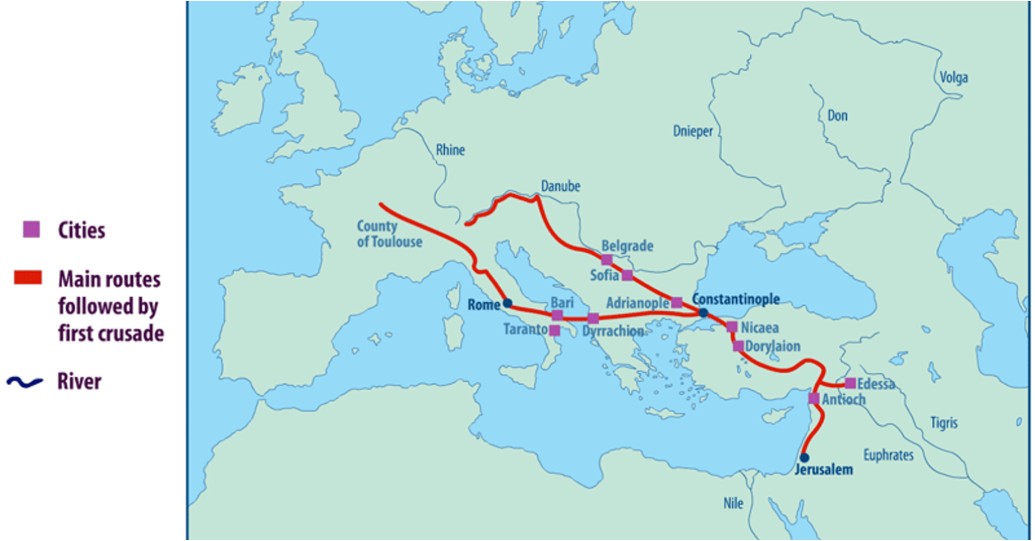
The mere fact of this risky transaction, what it entailed and what it made possible, is astonishing in itself, but subsequent events suggest that it was actually worth the risk. From being a nonentity, a military failure, unmarried and with no heir, no reputation, a Duke of Normandy not fully in control of his own Duchy, Robert Curthose, for a short few years, became an eminent someone. He not only survived three years of heat and battle in Syria and the Holy Land but he was richly rewarded by the young Byzantine monarch. He had wealth and reputation. And finally, he was able to pick a noble wife – Sibylla of Conservano. They married in 1100 in Italy, and soon he was on his way home. He came back in September 1100 with a fortune sufficient to redeem his duchy, a warlike reputation and a bride. He was now someone of note. But then he discovered that, in his absence, everything had changed.
At the beginning of August 1100 King William Rufus was killed out hunting in the royal forest of Brockenhurst. With lightning speed, his brother Henry made a successful gamble for the throne and had himself crowned King within the week. This meant that when Robert returned, one month later, with sufficient funds to pay off the loan, he found that the loan was no longer redeemable. Henry had not only made himself King of England, he was making moves to destroy Robert’s credibility in Normandy. And he would spend the next six years trying to displace Robert in his contested dukedom.
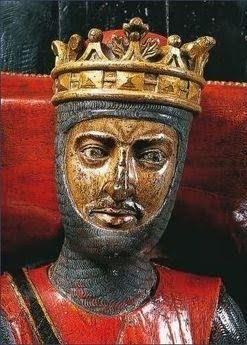
Thus, Robert’s hard-won glory faded in a series of defeats and checks. Sibylla died in March 1103, shortly after giving birth to a son. There followed years in which Normandy descended into chaos while warlords and rebellious nobles fought among themselves. Lawlessness was widespread, people were displaced, bands of thieves roamed the countryside. Men said that Robert Curthose was unfit to rule. He never redeemed his duchy. His reputation took a plummet.
It had to end in battle. The rancour and hostility between the brothers raged until the end. Robert and Henry fought their final battle at Tinchebrai on 28th September 1106. It took a little over one hour. Here Robert’s luck finally ran out. He was even denied a heroic death on the battlefield. Instead, he was captured. He became his brother’s prisoner. His imprisonment lasted for twenty-eight years.
In 1134, Robert died in Cardiff Castle in his early eighties. Robert Curthose, sometime Duke of Normandy, unlucky eldest son of the Conqueror, was buried somewhere in the abbey church of St. Peter in Gloucester (which subsequently became Gloucester Cathedral). No-one knows where.
Robert Curthose is one of the leading characters in After the Arrow, a novel which gives a dramatic interpretation of his life and relationships.
In Deaths, Disasters and Destinies: Anglo-Norman History in Twelve Lives, Chapter Nine "Unfortunate Life and Death of Robert Curthose" gives an historical overview and assessment of the events and misfortunes of his life and death.