One of the themes of The Remarkable Tale of the Bull and the Sheep is a genuine historical romance around which a mystery has grown. It offers a tantalising glimpse into the private world of a nunnery and the hard world of a war-like nobleman. The details are not easy to recover but at its centre is a romance of startling tragedy. As you can see, this is the most promising material for a novelist. But even more mysterious is the way the whole story bears traces of having been suppressed, indeed it might have been irrecoverable had it not been for two astounding letters between people deeply concerned with the events which took place in 1093.
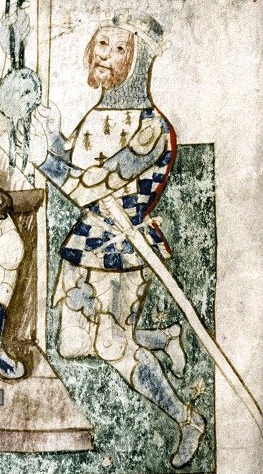
Count Alan Rufus is an important minor character in the novel. In real life he was an important major player in the post Conquest politics of the north of England and the borderlands between England and Scotland where it was imperative that a strong, commanding presence in the form of a vassal loyal to the king should be in place. Count Alan Rufus was, for many years, that presence, first in the reign of William the Conqueror and then in the reign of his son William Rufus.
But how does this hard warrior become the hero of a romantic tale?


My starting place for this character was to look for him in real locations. In Richmond, in the castle he built on a hilltop above the River Swale, consisting of a huge foursquare Norman keep, bristling with defences of the type you would expect a great warrior and hard man to build. But also, nestled up against the south-west corner of the castle site, a luxurious private dwelling.

Now largely in ruins, this was once a two-storey, well-heated, well-decorated set of rooms accessed up a wide flight of steps, featuring a magnificent doorway with a moulded arch brightly painted with his Breton ancestors. This was Count Alan’s private apartment. For me, these two contrasting buildings, bearing testament to quite different parts of his nature, spoke eloquently of the sort of complex man Count Alan Rufus might be.
In 1093 Count Alan is in charge of escorting King Malcolm of Scotland to a peace negotiation with the English king, William Rufus, at Gloucester. As Count Alan prepares to read out from the list of terms, we have a glimpse of him through the king’s eyes (The Remarkable Tale of the Bull and the Sheep, p. 103).
William’s attitude to Count Alan Rufus was based on the respect of long and faithful service in defence of the northern borders, mixed with admiration of his personal qualities. Here was the type of man that women admired, men aspired to be and kings schemed to get in their inmost circles. Instead of reading from the list, Count Alan set it aside and spoke his own words.
‘My lord,’ said the Count, ‘the King of Scotland desires to know, plainly and with certainty, whether you will, now or in the future, be prepared to press a suit of marriage with Edith, his daughter. And I must also add, my lord king, so there is no risk of future allegations of deceit or misrepresentation, that if you desire no marriage with the said Edith, he intends to give her in marriage to me.’
Such plain speaking momentarily baffles the king, but it is indicative of Count Alan’s frank, plain speaking and absolute loyalty to the vassal oaths that he has sworn. One of the key elements of his character, I thought, is that he keeps his word. In Norman society, though much misconduct could be tolerated among the magnates, disloyalty would always be condemned.
In turn, William’s reply momentarily baffles Count Alan. William knows something about Edith, whom he himself once considered as a bride (p. 104).
‘Count Alan, I fear you have been misled. Whatever Malcolm has been saying to you, whatever prospects he has been holding out, if they concern his daughter, they are worthless. Edith has taken the veil. Do you not know that she is a nun at Wilton? I fear that neither I, nor you, can marry the lady […] Alas, as a nun she is inviolable. Who can overturn the holy rituals of the church, who can countermand the vows of religion? Perhaps King Malcolm ought not to persist with his suit here but proceed directly to Wilton and attend to his daughter.’
After this astonishing encounter, King Malcolm descends on Wilton to find out the truth about his daughter, Edith. It is this matter that brings Count Alan to Wilton where, he soon discovers, Edith is not the only royal lady in residence. Now the romantic element of the story begins. Count Alan meets Gunhild, the daughter of the late king Harold, who died at Hastings. She has been living at Wilton for many years, receiving a fine education and perhaps expecting one day to become abbess. But why, in that mercenary age of arranged marriages and controlled women, do we consider that what happens next is in any way romantic?
Under the eyes of the nuns, their behaviour is circumspect, but it proceeds over the next few weeks, watched by Gunhild’s friend Aefled (p. 110).
“Every day he came to the abbey to spend an hour or two with her, walking and talking in the cloister garth. Soon Gunhild was looking forward to seeing him, then expecting him, then hastening to meet him. They walked and talked, often lingering by the roses, still pouring their fragrance on the late summer air, as they had when King William had hidden there to glimpse the bride he did not want. Now Count Alan and Gunhild loitered among the red August blooms, sharing their sweetness in warm looks and unspoken thoughts. Aefled could clearly see what was happening. Months ago, when they had first begun their friendship, Gunhild had said: ‘Don’t you think love is the most important matter, the fullest and best of human life?’ If Gunhild really thought that, then it was likely she would risk everything for it. Her words came echoing back. ‘If I was offered the chance, whatever the odds, I would take it.’ Count Alan was offering that chance. There was no doubt that the formerly self-possessed Gunhild had fallen passionately in love.”
But was Count Alan in love? Impossible to tell. At this point we have to fill in the blanks and what helps us do that are the two surviving letters from Archbishop Anselm to Gunhild dated sometime after these events. Drawing on these letters I think a case for romance on both sides can be made. And for a novelist the material is so rich as to be irresistible.
The romance turns on a key moment in the cloister garden at Wilton (p. 110).
“On the day before he was due to depart, Count Alan plucked a rose to offer to her. As he did so, he pricked his finger badly on a thorn. He sucked away the blood, laughing that he had taken many wounds in his long life, but never before in the service of love. ‘Look, it’s the same colour as the rose,’ he said, ‘a perfect match, like us.’ Gunhild thought, at last, she knew what happiness was. In a few days, Count Alan, so admired among courtiers, noblemen and war lords, even by the king himself, had found and won a noble love from a woman equally admired. He promised himself that he would treat it gently, respect it, treasure it, and if could, nourish it with love of his own. It was a promise he was to keep to the end of his life.”
All the known facts suggest that Gunhild and Count Alan left Wilton together and that their intention was marriage. Here the trail is unclear but there are suggestions that they made their way across country to Count Alan’s holdings in the Fleamdyke Hundred, about thirty miles from the Abbey of St Edmundsbury. There are accounts that put Count Alan and Gunhild at the home of four named people living in that area, almost certainly tenants. What is more certain is that within a short time after the elopement Count Alan began to feel unwell, his condition worsened and he took to his bed with a fatal illness. Certain clues suggest that it might have been tetanus.
Before they have time to be married, Gunhild and Count Alan are parted by death. Gunhild asks herself if this is God’s punishment (p. 121).
“Although close to panic, Gunhild tried to appear calm as she sat at his bedside hour after hour watching the terrible progress of the disease through all his limbs. Now, for the first time, her thoughts turned to God. Was this a visitation of heaven’s vengeance for her renunciation of convent life? Was this her punishment, to lose the last chance of earthly happiness which marriage to this man would give her?
That night, before the disease reached his face, closing his jaw and locking it so that he could no longer speak, he held her hand and whispered: ‘Regret nothing, Gunhild. For a little time, we had a great love.’
Gunhild shook with grief. Hot tears rolled down her cheeks and fell on his swollen hand resting on the bed, the hand where the disease had started, the hand with which he had plucked the rose at Wilton, the hand which had been pricked by a thorn.”
Gunhild turns to Anselm for spiritual advice and support. There is extant some correspondence which reveals that they exchanged quite intimate thoughts about the death of Count Alan Rufus. Anselm urges Gunhild to return to the conventual life and seek forgiveness for having abandoned it. Clearly Anselm thinks she has risked her soul by this action. Meanwhile news of the sudden death of one of the king’s most staunch supporters does the rounds. Many people make the connection between Count Alan’s abduction of Gunhild from the convent and his subsequent death. When King Malcolm dies suddenly not long after taking Edith away from Wilton, the rumours gather momentum. This apparently stern divine judgement is major news which destabilizes the north for a time and finally reaches the king.
When he hears the news, William Rufus is disturbed and reveals his private thoughts to Ranulf Flambard (p. 130).
‘Flambard, I grieve for Count Alan. A man fit for admiration and respect. A loyal vassal and brave. What possessed him? What happened to him at Wilton? Did he lose his senses?’
‘I can offer no explanation, my lord, either of his conduct or of his death.’
‘Many say he was struck down by God for violating a nun.’
‘Many say that, my lord, and there is a certain mysteriousness in the confluence of these events. In September, Count Alan is struck by disease and dies. In November, Malcolm is ambushed and killed. Within a few weeks of leaving Wilton, both men have encountered terrible fates.’
William Rufus gave a shudder. ‘It’s as though they have been punished for taking away from Wilton women whom God had called to his special blessing.’
Ranulf would say in after times that the king was genuinely moved by Count Alan’s death and the reasons for it. For several days he was moody and downcast, seeming to absorb great lessons from this event. He made inquiries after Gunhild, wishing to know more about her whereabouts, the events at Wilton and the manner of Count Alan’s death.
For an historical examination of the known facts, including the revelatory letters exchanged between Archbishop Anselm and Gunhild, see Deaths Disasters and Destinies, Chapter Three "The Tragic Love of Gunhild and Count Alan".
For a very different perspective on the story, written in the style of a breaking news story, see NEWS FROM THE PAST – Elopement Scandal Hits Royal Circle.