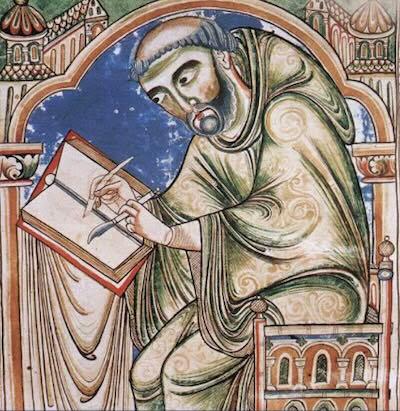
Orderic Vitalis was born in or near Shrewsbury in 1075. At the age of ten he was sent by his father to become an oblate child at the Benedictine Abbey of Saint Evroult in Normandy where he remained for the rest of his life. His work ‘Historica ecclesiastica’ is generally considered the most valuable for Norman, English and French history in the period 1082-1141.
Sometimes Orderic writes from personal knowledge or eyewitness accounts, his own or the verbal accounts of older monks. He also draws on written sources such as the cartularies of monastic houses or the chronicles available at Saint Evroult.
In March 1091, when he was sixteen he was made a subdeacon and two years later on the 26th March 1093 Bishop Serlo of Sées made him a deacon, which post he held for fifteen years, becoming a priest in 1107
The events of the Haircut at Carentan in which Bishop Serlo played a leading part take place in 1105 and are recorded by Orderic.
In one of those rare, felicitous gifts to the novelist it sometimes happens that historical fact and imaginative fiction collide. On these occasions facts arrange themselves with something like the boisterous enjoyment of inventive imagination.
The events around what I am calling ‘Haircut at Carentan’ in Chapter Nine of After the Arrow are of that sort. The title refers to a literal haircut that Bishop Serlo is recorded as giving to King Henry and his followers in the church at Carentan at Easter 1105.
This extraordinary scene is recorded by several writers, including Orderic. Whether Bishop Serlo ever spoke to him about it we don’t know, but we can guess that Orderic would have loved to know the truth, even if he dared not ask. The distinguished medievalist and historian of this period, Margaret Chibnall, suggests that Orderic writes an ‘unforgettable’ scene when he describes the events at Carentan. She suggests that it is possible, but not proved, that he was present. Even if he was not, Chibnall accepts the following story of what happened on that day as true.
Again, you might say, no, the facts are being frivolous, these accounts cannot be facts at all, they are wrong, false, fake. But then you check again and what emerges is the conviction that these events actually happened. Events that are tragi-comic, farcical and of the gravest consequences to the people who took part in them. But if it is difficult to believe, this scene is also impossible to ignore. And it almost certainly happened in more or less the way in which it is recorded by Orderic Vitalis in Book Six of the Historia ecclesiastica.
This is the scene as I adapted it for ‘Haircut at Carentan’ in my novel After the Arrow.
Henry 1st king of England comes to Carentan at Easter 1105. Many parts of Normandy are in rebellion against Robert Curthose, Duke of Normandy and Henry’s brother. But Carentan, in the Contentin penninsula is territory loyal to Henry. Even so, the people do not feel safe (p. 204).
“Hardly a town, rather a cluster of houses racked up against a church whose half-finished tower looked as if it had been bitten off, squatting in marshy land around the estuary of the Douve, Carentan woke up one morning and found itself at the centre of Anglo-Norman affairs. People streamed in from all sides, nobles and magnates, churchmen in search of a ‘protector,’ among them the Bishop of Sées in self-imposed exile from a diocese sacked by the excesses of Bellême. Priests and monks from burned-out monasteries, on horses, donkeys and on foot, were filling the roads from every direction, all ready to welcome with open arms a saviour king.”
Terrified for their goods as bands of robbers ravage the countryside in the wake baronial wars led by men like the Robert of Bellême, the people fill the church with their most precious possessions, thinking they will be safe there (p. 204).
“From the west door, all the way up the nave to the pillars of the crossing, the church was packed. Not with people but things. Objects of all sorts, chests, wooden artifacts, clothes presses, domestic items of copper or iron, trade tools and ploughshares, all higgeldy-piggeldy as if shunted in, stacked and abandoned in a hurry. Lofty romanesque arches loomed above the precious chattels of frightened people in fear for their belongings. No more eloquent statement could be made about the dire condition of Normandy”.
On this day, Easter Sunday 1105, Bishop Serlo of Sées is going to make a plea to Henry to save Normandy (p. 205).
“After the Eucharist, Bishop Serlo launched upon his carefully-prepared sermon which fell roughly into two parts. The first part was an impassioned justification of the invasion and was spoken directly to Henry who stood on the altar steps, head bowed, in a studied attitude of humility. ‘All Normandy is dominated by banditry, and lacks a true ruler,’ he began. ‘Look around and see everywhere the result of savage depredations.’ He swept his hand to indicate the piles of goods stacked about the church. ‘Fear, alarm and outrage stalk the land. No man feels safe, either for himself or his chattels.’ He turned towards Henry: ‘We implore you to rise up boldly in the name of God, win the heritage of your father with the sword of justice and rescue your ancestral lands.’ In a speech that gave every sign of having been approved beforehand, Serlo went on to attack Robert Curthose: ‘Your brother does not truly hold Normandy, nor does he govern the people as a duke ought, leading them along the path of righteousness. Sunk in lethargy, he is dominated by men of little worth. He squanders the wealth of a great duchy on trifles and follies’”
A personal attack on the king’s brother by a Bishop in the church on the holiest day of the year is not something to undertake lightly. It is almost certain that this dramatic scene had been sanctioned in advance by Henry who needs strong justifications for his forthcoming war on Curthose (p. 206).
“Then Serlo moved on to use the classical but commonplace imagery of the state as body: ‘When the head is sick, the whole body is afflicted: when the ruler is foolish, the whole province is in danger.’ And so on and on. [….] But as a piece of rhetoric designed to heighten the image of the ‘saviour king’, Serlo’s sermon was undoubtedly effective. It was the public proclamation of Henry’s fittedness to rule, staged before an altar on the holiest day of the year. Acclamations followed this part of the sermon, led by Meulan, as Henry was prevailed on to undertake the conquest of his brother’s realm. Meulan asked for, and got, Henry’s sworn oath to restore peace and order in the name of God. But something more was needed. Up to this point Henry looked like any greedy invader, making claims to justice and right as a casus belli. Something more was needed, something that would transform a public display of martial intent, thoroughly grounded in worldly motives, into a sacred undertaking. As he embarked on the second part of his sermon, Bishop Serlo was about to provide the opportunity for such a transformation”.
Then comes the truly astonishing and most unlikely element of this whole stagey scene. A diatribe against hair (p. 206).
“Clean shaven Bishop Serlo, whose head was completely bald, as smooth and pale as a pearl’ [….] did not mince his words. He began by calling on the authority of St Paul: “If a man has long hair it is a shame unto him.” By growing their hair long, thundered Serlo, “ men make themselves imitators of women.” And he went on to complain that “beards give men the look of billy-goats, whose fifthy viciousness is shamefully imitated by the degradations of fornicators and sodomites.”
It is most probable that Henry had collaborated on this speech and approved the whole scene. It is perfectly designed to supply the religious and moral backing for what will actually be invasion and overthrow. The seizure of Normandy, a Christian duchy, legally held by Robert Curthose who is a returned crusader and has the blessing of the Pope, could certainly be viewed as so immoral as to put Henry’s credibility in doubt. Something more is needed, something symbolic of ritual sanctification. So at this point Serlo does something truly extraordinary (p. 207).
“After a sustained attack against his pet hate, Serlo brought the Easter Mass at Carentan to its emotional apogee by suddenly producing a small pair of shears. Observing that the King, Meulan and many of the magnates around Henry were in possession of offensive locks, Serlo waved the shears and challenged them to a haircut. One by one they bowed their heads and succumbed. It was a ritual shearing, a dedicatory sacrifice, the purification of warriors before battle. By the time the royal entourage left the church at Carentan they were as closely shorn as their all-conquering forefathers in the days of the Conqueror. Soon afterwards an unstylish troop of would-be conquerors, re-branded as the army of Christ, was to be seen riding east towards Bayeux.”
There is no strong reason for doubting the truth of these events. King Henry was setting himself up as the proclaimed Saviour of the Norman Churches in order to get the justification for launching a fratricidal war. It is completely believable that Serlo of Sées, who had personal reasons for hating Curthose, wanted revenge. Serlo had lost his see and his authority, seen churches burn, seen his flock turned out of their homes. Marauding bands of warlords were devastating the countryside while, as he saw it, Curthose did nothing.
Bishop Serlo was not the only inhabitant of Normandy who believed that Henry 1st would bring peace. However, he would have to wait until the following year, 1106, to see Henry carry out the task for which he had pleaded so eloquently at Carentan with sharp words and a pair of shears.