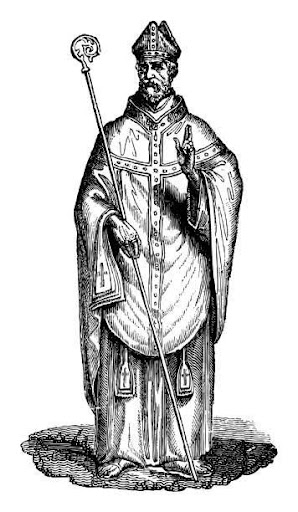
Bishop Walkelin is a minor character in The Remarkable Tale of the Bull and the Sheep, where his interactions with William Rufus throw a light on the character of King William II. There are certain indications that Walkelin was able to steer a path around the king’s moods and that the two men possibly shared a sense of humour. I like to think that this was so, that they had a personal as well as an official relationship. That Walkelin was by nature a diplomat which gave him an ability to handle the prickly, satirical king. Walkelin had known William II as a child since the days when he was chaplain to William’s father, the Conqueror. I felt this might give their relationship a special familiarity, as childhood connections so often do. Details of Walkelin’s early life are lacking but, before joining the royal house-hold, he was probably a canon at Rouen Cathedral and may have met the Conqueror and his wife, Matilda, through their strong connections with the clergy in Rouen.
Walkelin became Bishop of Winchester in 1070, after the deposition of Stigand who was excommunicated. The royal Treasury was kept at Winchester and the Conqueror needed someone in the post that he could trust. Walkelin was still there in 1093 when the Conqueror’s successor, King William II, stayed with him in Winchester on his way to Wilton Abbey.
It was this event which I chose to dramatize in The Remarkable Tale of the Bull and the Sheep because I felt that it gave scope to think about his character. How did this distinguished prelate steer his way through the volatile post-conquest years, how did he retain royal favour and patronage, avoid controversy in the church, rebuild and expand the cathedral and maintain a significant presence at nationally important events? Aside from all this activity, what was he like as a man?
When we first meet Walkelin in the novel he is playing host to a sudden visit by the king, brought about by William’s questionable sense of humour and irrepressible good spirits. Although he had recovered from a severe illness earlier in the year, which had filled him with positive energies, it had also alerted him to the risk of dying without an heir. At thirty-three he was still not married. Clearly, he must seek a bride. It is this mission that brings him on an impromptu visit to Winchester in the summer of 1093.
The nearby Abbey of Wilton is his actual objective, where Edith, the thirteen-year-old daughter of the King of Scotland, is being educated. But before going on to Wilton, the King decides to make a call on his good Bishop of Winchester where he expects his whole travelling entourage to be feasted and accommodated for the night at Walkelin’s expense.
I imagine the scene as the dismayed prelate greets his king and fronts up to playing the part of welcoming host (The Remarkable Tale of the Bull and the Sheep, p. 81):
“Bishop Walkelin appeared at ease and made a speech of welcome. He was a dignified old man, short and inclined to stoop. Immensely learned in theology and an expert in administration, he had guided the ecclesiastical estates of Winchester with a sure hand for twenty-three years. He oversaw the treasury and the royal mint on behalf of the king with scrupulous honesty. His greatest project was the building of a new Minster which he had begun in 1079, launching himself on a long-drawn-out battle for money.”
I thought it likely that William did not fail to notice that, although Walkelin was always short of money for his ambitious building projects, he kept his hands out of the Royal Treasury. Perhaps for that reason William decided to be unusually generous (p. 82):
“It was not until William granted the bishop half a hide of land in the Isle of Wight, with license to search for and excavate stone, along with forest to supply the timber, that Walkelin had been able to make real advances in his building project. The king, who liked to be congratulated on his more liberal acts, nodded graciously when Walkelin thanked him.
‘It is due to your generous gift, my lord king that the monks were finally able to move into the new Minster this very spring, towards Eastertide.’
‘That would have been during my illness. Alas, this year, for me, there was no spring.’
‘We offered daily prayers for your return to health, my lord.’
William Rufus raised a goblet ‘And I drink to your health, my lord bishop and thank you for your hospitality. […]
‘Our work of glorifying God through the raising of these magnificent new foundations is proceeding with such success it is likely to lead us into the sin of pride.’
‘Or greed,’ said the king. ‘Certainly, the church is finding enormous sums from somewhere.’
I think of William as needling the bishop, whom he actually respects, because that is his nature. An unorthodox sense of irony, the dig of the elbows, a joke at someone else’s expense, was how I imagined the humour of William Rufus (p. 82).
“Flattering the bishop with complimentary remarks about the splendour of the table, William made a joke about there being ‘no money left’ in the Winchester treasury.”
I imagine William as a man who makes jokes that almost no-one else thinks are funny. There is one more major scene involving Walkelin when, in October, 1097 a meeting in Winchester is called by the King to resolve the question of Anselm’s disobedience. At this time, Archbishop Anselm is determined to go to Rome to meet with the Pope, against the express wishes of William. A Council is called. What William wants is either a quiescent Anselm, or his exile from England. For a man with a conscience like Walkelin, I see the position as delicate (p. 273).
“Early on the day appointed for the meeting, Bishop Walkelin of Winchester walked up from his palace of Wolvesey bending over his stick as if his conscience was weighing him down. Old, tired, feeling he had not long to live, he regretted that he had not supported Anselm at the meeting in August. Even though he did not agree with his demands, it went heavy with him that the primate of England had found no one to stand with him against the king. But Walkelin had known William for years, had been chaplain to his father and had received bounties from his hands, as when he was granted land in the Isle of Wight for the building of his great new Minster. He admired Anselm and respected William, he could see both points of view, hurtling along like two solid bodies on the course of inevitable impact. Arrived at the Conqueror’s old palace where the king and his court were lodged, he went into the royal chapel and said a few prayers, asking God to look kindly on the coming discussions, then took his place in the great chamber among the assembled barons and bishops who had come to hear Anselm’s latest petition. He knew, as well as anybody there, that the archbishop’s position was perilously close to treason. By constantly pressing for leave to go to Rome, and by threatening to go without the king’s permission, he was putting a higher value on his allegiance to the pope than to the king.”
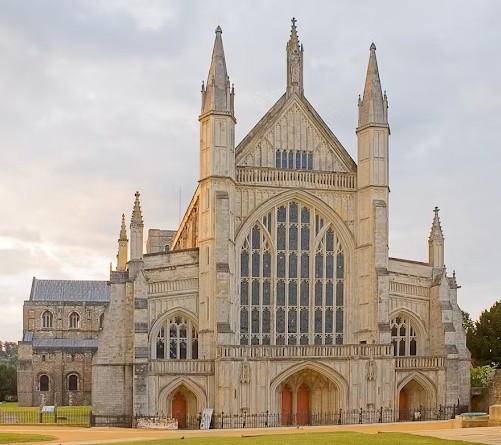
As a loyal supporter of William who is also a man of conscience, Walkelin is tormented. At the time of this Council he himself has only a few more months to live. He wants to go to his maker with a clear conscience. I wanted those prayers alone in the chapel that day to signify something of his character as a conscientious man of his times and his dilemma as a bishop with loyalties to both his king and his Archbishop.
Bishop Walkelin began the construction of the new Minster at Winchester in 1079 but did not live to see its completion, dying in 1098. It was completed under his successor, William Giffard, who appears as a minor character in The Remarkable tale of the Bull and the Sheep and After the Arrow.