January 2026
In my article of 2019, I wrote about the then current media iconography that surrounded Greta Thunberg which portrayed her very distinctly in terms of the symbolic representation of sainthood. This article seeks to update the picture.
Has Greta lost some of her charisma, has the icon become tarnished with the imperfections of worldliness, as many saints have in the past? Perhaps in a list of canonised people with contentious sides I would put St Joan, St Thomas More, St Thomas Becket as my favourite tarnished saints.
St Joan

In medieval times it was possible for women, even young girls, to achieve monumental status through some activity that connected them to holiness. For example, Joan of Arc, a simple peasant girl from the countryside of Lorraine, became a soldier in the army of the King fighting against the English occupiers. Claiming divine calling and special protection of the Holy Mother, she was accorded status by men, but not always by churchmen. But men could not forget the politics, and eventually she was destroyed by politics and power.
Something similar seems to be happening to Greta. These days she is not presented as the Holy Maid of Stockholm that she was. When young, her ivory face, angelic look and sporadic mutism were very much in the tradition of saintly iconography and her message was well understood, without controversy, and appealing. Now her messages are confused, contentious and sometimes controversial. Her face is often portrayed as scowling, disapproving. The iconography has morphed into something altogether more critical. Her public reception has also changed profoundly.
A crucial point of comparison between Joan and Greta is youth. Both were very young when they came to public notice: Greta was 14 and Joan 16 or 17 (although records are unclear). Fresh, virginal, with a clear message, they rose from the people and gravitated towards power –the royal court in Joan’s case, the circus of public media in Greta’s.
Early success and public fame came quickly in both cases. In both cases a popular cause was promoted. Joan against the English occupation, Greta against the forces of planet pollution. Later both encountered controversy, malicious stories, accusations of ‘going too far’ and a withdrawal of public support.
Both made very long journeys within the context of their times – Joan travelling from Domremy, to Paris, to Orleans, to Reims, to Patay and so on. In the early 15th century these were gruelling journeys, undertaken with some hardship and discomfort. Greta voyaged lengthily to avoid flying, making her journeys as difficult as possible in her commitment to a cause.
Both suffer set backs in public perception. Joan fails at the Siege of Paris and the Siege of La Charite in September and November 1429. The glow dims, she becomes a target of the powerful. Similarly, Greta stirs public disdain when she begins a more aggressive style of campaigning and takes up controversial causes. There are the first signs of unpopularity. The tarnish appears.
Tarnished Saints
Saint Thomas Becket
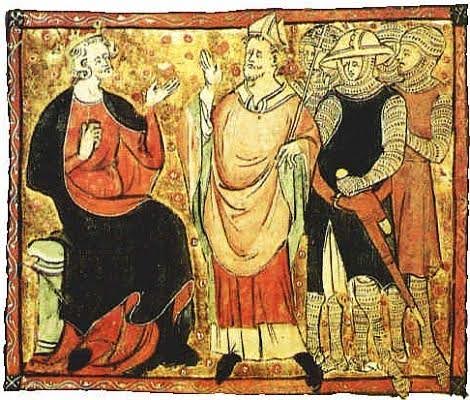
He was undoubtedly controversial, complex and stubborn. Like Greta, he dared to speak accusingly to powerful people. After King Henry II appointed him Archbishop of Canterbury, they fell out and the old friends became bitter enemies; later Becket found himself in the position of defender of the church against the worldly power of kings. When this became dangerous, he fled abroad. Eventually returning to Canterbury, where he was still Archbishop, he was murdered in the Cathedral, some say at the behest of the king.
Sainthood often involves not only contumacy, opprobrium and bad press, it can also lead to public disappointment. Canonisation may happen only in the long term as with Thomas More, or soon after death as with Becket. The faithful throughout Europe immediately began venerating Becket as a martyr, and a little more than two years after his death – on 21 February 1173 – he was canonised by Pope Alexander III in St Peter’s Church, Segni in Italy. Within a short time after canonisation his shrine at Canterbury became one of the richest in the country and a major site of pilgrimage.
St Thomas More
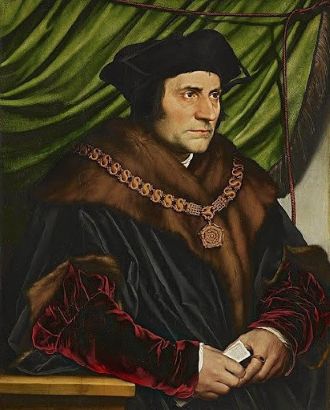
Thomas More was another contentious saint. Canonised by Pope Pius XI in 1935, four hundred years after his death, his reputation had mutated during that time. Fierce in his defence of Catholicism in the teeth of the Protestant Reformation, Thomas More pushed the boundaries of Christian charity and earned a great deal of infamy because, like Greta, he was greatly opposed to developments in contemporary society. Some say he went too far, even to the torture of heretics in his own house. Who knows? Greta is often charged with going too far, that is, beyond the bounds of generally acceptable behaviour. But perhaps that’s just what reformers do. Pope Pius XI canonised More in 1935 as a martyr. Pope John Paul II declared him the patron saint of statesmen and politicians. In his proclamation of 2000 the pope stated: “It can be said that he demonstrated in a singular way the value of a moral conscience … even if, in his actions against heretics, he reflected the limits of the culture of his time”.
A moral conscience is necessary in order to undertake the arduous work of a reformer but it can also alienate by coming up against the limits of contemporary culture, as we have seen in some public responses to the latest activities of Greta.
Greta has alienated a degree of public opinion by losing the clear climate message of her early days in a confusion of political messages. The figure of youthful vigour proclaiming a simple truth no longer applies. The purity of her approach in a single focus has become diffused among a plethora of ‘causes.’ The iconography of the ‘pure maiden’ has been superseded by an iconography of contention, dispute and controversy.

Like Becket and More, Greta Thunberg was not shy of speaking unsavoury truths to power. In her speech during the plenary session of the 2018 United Nations Climate Change Conference, she said that the world leaders present were “not mature enough to tell it like it is”. Saints often had to talk tough to kings and popes, like St Anselm, for example, who fell out with two kings and was exiled on at least three occasions and spent time travelling around the great monasteries of Europe. Like many medieval saints, who travelled widely, Greta made long journeys to preach or convey her message. She sailed across the Atlantic to avoid climate damage. But then her message got confused, more political, more radical. She was detained by Swedish police for taking part in a pro-Palestinian protest outside Malmö Arena in May, and subsequently released a statement opposing Israel’s participation in the Eurovision song contest. Lately, her pro-Palestinian stance has led to greater controversy and her pure climate message has become diluted. She is growing up and is no longer the iconic youthful saint figure. As we have seen, saints are very often strongly against something.
One day she, too, may become a significant political figure, and as the iconography changes, so will her public image. We now have an ‘activist,’ a morally dubious designation since activity in and of itself is not a virtue but only becomes so when transmuted into the power of unifying benevolence.
As we have seen, such an accomplishment is by no means the preserve of saints. Indeed, few saints achieved it.
The Holy Maid of Stockholm is in the process of metamorphosis. We await the outcome.