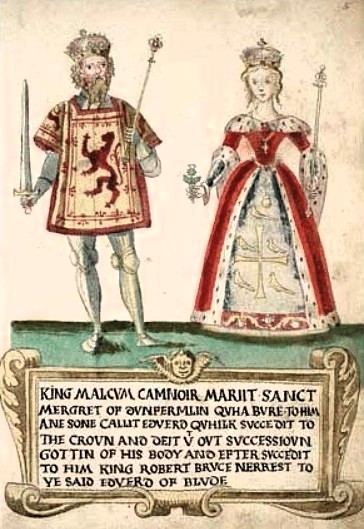
This Scottish king reigned from 1058- 1093. He was the son of Duncan I, killed by Macbeth. During his reign he had turbulent and precarious relations with his southern neighbour, sometimes spilling into open battle, sometimes cooling down in peace talks and negotiations. Malcolm resisted all Norman attempts to occupy his country, he promoted armed resistance in the borders and encouraged the English to rebel. Savage border fighting was later put down in the horrendous violence known as the Harrowing of the North when William the Conqueror devastated the northern counties and placed his own loyal henchmen in control. Through all this Malcolm steered a path, holding on to his throne for thirty-five years.
Malcolm Canmore appears in the novel The Remarkable Tale of the Bull and the Sheep, entering the story at the time he enters England, in the early summer of 1093. He is on his way to ill-fated negotiations with William II at his palace of Kingsholm in Gloucester. Malcolm’s reputation for fierceness and a fiery temper precede him, but it is not until he gets to Wilton that his rage explodes.
Led by suspicions that something is amiss, King Malcolm visits his daughter, Edith, at the Abbey of Wilton in Wiltshire where she is being educated, Wilton being a renowned place of female education in Latin and French as well as theology and the discipline of Benedictine life.
At the Abbey a dramatic scene plays out when King Malcolm suspects that his daughter, whom he intends to bargain away in marriage, is being compelled to become a nun. There is a terrible scene. Frankly, it is this aspect of his role that is important in the novel – the remote and frightening father of young Edith.
Without hesitation he immediately cuts short her education and carries her away from Wilton, the only home she has known for the last eight years. Malcolm whisks her back up to Scotland where she remains for several unstable years.
The extraordinary events happening at Wilton in the summer of 1093 have been heavily documented and were the subject of discussion in the very highest circles at the time. This means that it is possible to reconstruct the detail of events in all their spectacular drama.
What really happened at Wilton?
1093 was a bad year for Malcolm. In November of that same year he was killed in a battle, or ambush (accounts differ), along with his eldest son, at Alnwick, Northumberland, just as he was setting out to invade England on 13th November 1093. Queen Margaret it is said, died of a broken heart three days after hearing of the deaths of her husband and eldest son.
See Chapter Five “A Plucked Rose” in The Remarkable Tale of the Bull and the Sheep.
Dunfermline Abbey
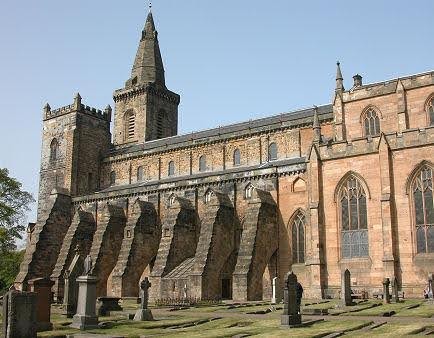
Dunfermline Abbey was founded by Queen Margaret who was known as a pious lady as well as a prolific one (she produced eight children). Upon hearing of the death of her husband and eldest son in the first Battle of Alnwick she died, it was said, of grief. She was canonised in 1249. Her daughter, Edith, who hardly knew her, went back to Wilton after the sudden death of her parents and continued her education. She did go on to marry, in fact she married King Henry 1st of England and so, like her mother, became a Queen.
Edith’s story as a child is told in The Remarkable Tale of the Bull and the Sheep.
Her later life as Queen of England is told in After the Arrow.