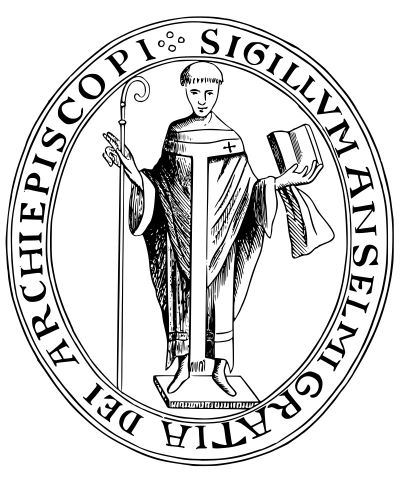
By the end of his life, Anselm had achieved most of his aims. He had written distinguished works of theology, instituted reforms and defended and maintained the primacy of Canterbury, winning recognition from Pope Paschal for himself and his successors. Most satisfying of all perhaps, he was finally working in partnership with the king.
In March 1109 a few weeks before Anselm’s death, King Henry wrote to tell him that the management of affairs in England was “to be governed by your will and settled by your advice. I have made this known to our justiciars.”
For most of his life Anselm’s image of the bull and the sheep yoked together at the same plough turned out to be a perfect metaphor for years of unequal strain as the plough slewed dangerously behind the two foremost powers in the land. By the end of his life he had realised his dream of rule as a partner with the king, the two powers yoked together at the same plough, pulling the church in steady state through a well-governed land at peace.
After sixteen turbulent years as Archbishop, Anselm died in Canterbury surrounded by his monks and long-standing friends, including Eadmer, who had spent years following Anselm around, even into exile, writing a life of the great man. He was among those who sat with him through his last hours. Perhaps he was wondering, even then, how he would write the final scenes of the life that was about to pass away. The following morning at dawn on Wednesday 21st April 1109, in the sixteenth year of his pontificate and the seventy-sixth of his life, Anselm died.
What should Eadmer say? How was he to portray this life, this man who had quarrelled with kings and twice been sent into exile, who had defended the church, and secured the primacy of Canterbury, who, in the eyes of many, had worked miracles and deserved to become a saint? What would the world say? What verdicts would be passed?
There is scope for many views. An obvious beginning might be made with a bland general statement, perhaps something along these lines:
“The span of Anselm’s life covered one of the momentous periods in European history.”
However, a shrewd chronicler might comment with non-commital reserve:
“With his combination of political conservatism and intellectual and spiritual innovation he represented the forces of his age. Already calling himself an ‘old and feeble sheep’ when he was forced to accept the archbishopric of Canterbury at the age of sixty, he laboured for sixteen years to align the office with his own principles, with his conscience and his vision of the religious life. Not altogether unsuccessfully.”
On the other hand, a theologian might focus on the writings:
“He wrote innumerable treatises, dialogues and sustained meditations, which, while they produced no immediate intellectual responses, were valuable additions to the development of contemporary theology.”
A court dignitary might point to international relations:
“He kept up correspondence with crowned heads and distinguished prelates all over Europe and often brought vexed issues to peaceful settlement through his talent for delay.”
Eadmer’s own experience would bear witness that:
“He cultivated lasting friendships but was not afraid to withdraw favour in the light of circumstances. He provoked fierce love and loyalty as well as irritation and disappointment, even in the same person.”
A gifted administrator like Ranulf Flambard, perhaps, would point out:
“He spent half his life in positions requiring business ability, but never learnt to love business or even to transact it efficiently. He had more opportunities for observing the changes of an age than most men, but he never saw himself as an instigator of change.”
And History itself might try, as History often does, to produce a level verdict:
“In the end he emerged triumphant from his battles with kings, settling the investiture question for two generations and defending the primacy of Canterbury until the end. His church reforms lifted the standards of priestly ministry and enhanced the security of church lands. He sought no wide influence and was happiest when talking to a group of pupils or with his monks gathered in the cloister. He touched the thought, piety and politics of his time at every point and whatever he touched looked different afterwards.”